

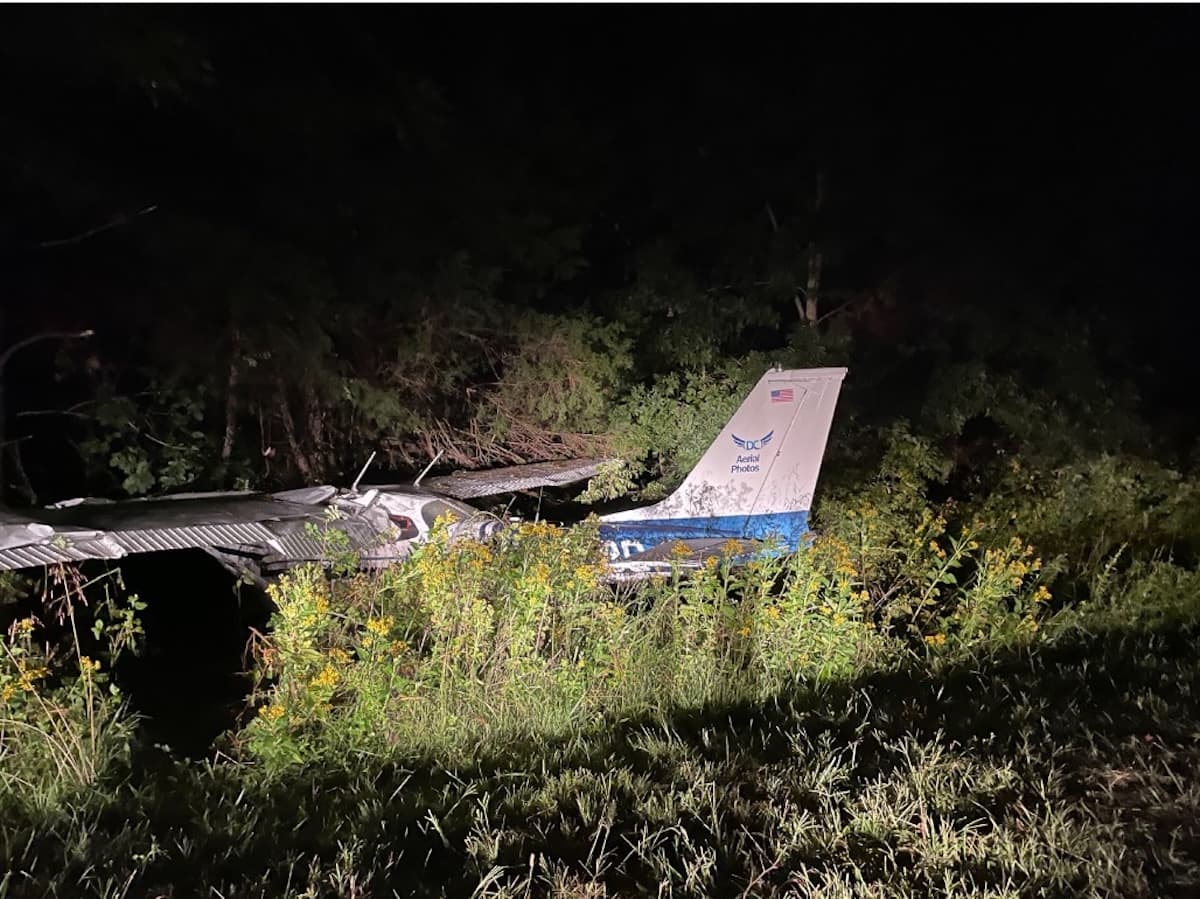
The pilot told investigators that the Cessna 172K had been stored in a hangar for two years awaiting an engine rebuild.
After the rebuild and an annual inspection, he planned to fly the plane back to his farm.
Following a preflight inspection, he attempted to start the engine but found the battery was too low. After a jump start, he departed, circled the airport, and headed toward the farm.
When the flight was about five miles from the farm, the engine lost total power, and he performed a forced landing near Fredericksburg, Virginia. After clearing trees along the approach to a pasture, he slipped the airplane to lose altitude and he began to flare the airplane about ⅓ of the way into the pasture.
He then noticed a gravel drive with utility lines and trees at the end of the pasture. He stated that since he still had sufficient airspeed, he pulled back on the control yoke, the airplane became airborne, and he was able to clear the utility lines and trees. The airplane then touched down hard. He told investigators that he ground-looped the airplane to avoid a river at the end of the pasture. The airplane hit the trees that he had just cleared before coming to rest.
The pilot sustained minor injuries in the crash.
During the post-accident examination of the airplane, about five ounces of fuel were drained from the fuel sump-gascolator and carburetor, with no contaminants or water present. Both the left- and right-wing fuel tanks were empty.
Examination of the engine confirmed compression on all four cylinders and continuity of the valvetrain. The cylinders and exhaust system components were examined with a lighted borescope with no anomalies noted. The left and right magnetos operated normally when tested. The spark plugs, ignition harness, and carburetor screen were examined, with no anomalies noted. The oil filter and housing were inspected and found to be free of contaminants. No anomalies were found that would have precluded normal operation of the engine.
In a subsequent written statement, the pilot stated, “My aircraft experienced fuel exhaustion while returning to my farm. I thought I had enough fuel to make it, but I didn’t and ran out of gas.”
Probable Cause: The pilot’s inadequate fuel planning, which resulted in fuel exhaustion and a subsequent total loss of engine power.
To download the final report. Click here. This will trigger a PDF download to your device.
This September 2024 accident report is provided by the National Transportation Safety Board. Published as an educational tool, it is intended to help pilots learn from the misfortunes of others.
In another subsequent written statement, the pilot should have added, “I hearby surrender my PPL to the FAA as I clearly shouldn’t be flying.”
among the most misleading headlines for a story ever published here.
C’mon guys.
If you think you have enough fuel, you don’t. Stop thinking and fill it.
IMO many fuel systems are very poorly designed. I want to say “amazingly stupid” from an engineering point.
Do you all remember the little petcock with a stand pipe motorcycles had below the tank?
You run out of fuel, switch to a known quantity of reserve and go to the nearest source of fuel.
You either need a reserve header or a really accurate fuel level indication especially for the last few gallons, that is alarmed. Hopefully both.
The fuel plumbing in most aircraft are well done. The exception is the Piper Warrior, PA-28 , with the fuel tank selector on the left side panel near the pilot’s knee….very difficult to see and verify the position.
The Cessna 172 has the selector on the floor between the front seats, easily visible from all 4 seats.!!
What is poorly engineered is the fuel gauge system. ..no filtering, so the gauge needle bounces and it operates on the battery voltage, which can vary from 12.5 to 14,5 volts.
Cars use the came hardware, but the gauge is heavily filtered, [ the needle moves very slowly], and cars use a precision voltage, usually 5.0 volts.
So, aircraft gauges can be very accurate if the car design was used….and use larger gauges !
I thought I had enough fuel says it all.
Boy, talk about a click-bait headline. What does “first flight after an engine rebuild” have to do with this crash? Nothing! The guy ran out of gas. That unfortunately happens all the time. Not nearly as sexy as a freshly overhauled engine coming apart on its first flight. This looks like a headline from USA Today. GAN should be better than that.
I thought it happened on the first flight after the engine rebuild
Wish the FAA would take the pilot license of those who run out of gas! Sincerely hope all these guys running out of gas are getting 709 rides, but they should be losing their license and have to start all over again!
Also have you noticed that the majority of the accidents are with pilots over 65 years old. Maybe we need annual check ride for them. One thing for sure, if your flying less than 52 hours a year your not current in my book.
Current? No way to tell without the logbook.
Proficient? Not hardly.
The article does not mention how far he was to travel. Good news not very far, bad news it required fuel to run the engine he did not have. The flight path is still on Flightaware.com under N7058G.
The 79 year old pilot, hmm. I know some 79 year olds who can climb up to look in a C172, I also know a few more who have zero chance of that. No idea which group this pilot was in.
It looks to be about 25 nm distance. So, he only needed 4-5 gallons, and didn’t have that much.
Poor preflight..!!!
If fuel is available, never leave the ground with out full tanks.
The FAA should make it mandatory to have an IQ test to get a pilot certificate. This is why insurance rates keep going up, stupidity
well.!…. more stupid pilot tricks.!
This older guy should have been able to stick the tanks and know if he had enough fuel.
So for the lack of a few gallons and $20, he wrecked the aircraft, and the new engine now needs a teardown……amazingly stupid.!!