

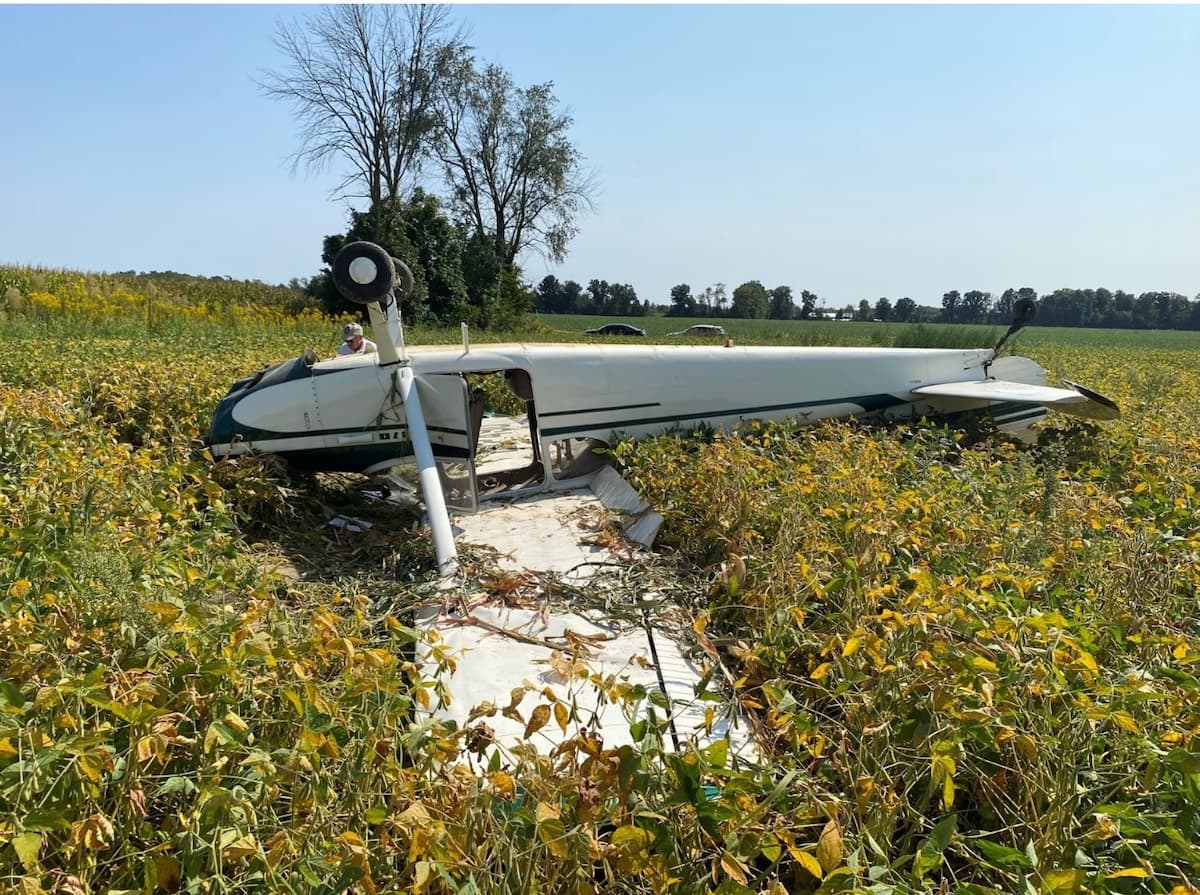
The pilot stated that during cruise flight at 3,500 feet above mean sea level and 120 mph, there was a loud repeating banging sound and a loss of engine power.
Engine oil temperature increased to 220°F, engine oil pressure decreased below 35 psi, and engine oil sprayed onto the Cessna 170A’s windshield.
As the airplane descended, he looked for an area to perform a forced landing near Marshall, Indiana. He planned to land on a short open area, but overshot the open area because he could not dissipate enough of the airplane’s energy. He then landed on a corn field where the airplane contacted the corn, nosed over, and hit the ground.
The airplane sustained substantial damage to the wings, vertical stabilizer, and rudder, while the pilot received minor injuries.
Post-accident examination of the engine revealed a hole in the crankcase above the No. 6 cylinder assembly. The No. 6 connecting rod was fractured near its base.
Metallurgical examination of the No. 6 connecting rod revealed fracture features that were consistent with fatigue cracking. The cracks initiated at multiple locations on the outer surface opposite the inner bearing surfaces that mated the crankshaft. These cracks propagated through most of the rod yoke arm cross section until the remainder subsequently fractured from tensile overstress. All other fracture surfaces were consistent with overstress fracture.
Maintenance records showed the engine received a major overhaul on Sept. 27, 2010. The last annual inspection on the engine was dated March 1, 2024, and the engine had 572.7 hours since the major overhaul. Continental manual M-O Ch. 6-3, Table 6-1 states: C125, C145 series, and O-300-A,B,C,D engines have a time between overhauls of 1,800 hours or 12 years, whichever comes first.
Probable Cause: The fatigue fracture of the No. 6 piston connecting rod, which resulted in a loss of engine power.
To download the final report. Click here. This will trigger a PDF download to your device.
This September 2024 accident report is provided by the National Transportation Safety Board. Published as an educational tool, it is intended to help pilots learn from the misfortunes of others.
150 hp O-200, yeah it can be done, but engine life and reliability are going to suffer. It is also going to cost a LOT more to build than a stock engine (which nowadays is far from cheap anyway). If the goal is to “go faster”, and honestly, nobody buys an airplane to “go slower” (except maybe 150 drivers like me), it is far more cost effective to reduce drag than increase horsepower.
To double the speed in the identical airplane takes quadruple the horsepower. Want to go 200 mph in a 150? Bring 400 horsepower – which isn’t likely from any O-200. You’re building an experimental, I’d spend my time, money and effort on fanatical drag reduction efforts and not have to worry about flying around behind a hand grenade of an engine. Jim Bede has some excellent articles on drag reduction. They’re on the net but you may have to dig for them.
So yes, while Wing’s 150 hp O-200 is definitely achievable, I might question if it is 150 reliable hp “all day long” and I doubt if it will happily churn along for 1,800 hours TBO. (If the answers are yes and yes, please tell me, too!)
Best Regards,
M/M
Major overhaul clearly means much more to me than some other people’s idea. A major overhaul means crank bearings, cam bearings – everything “major”; new piston rings, valve grind, all accessories checked and/or replaced, new engine mounts, plugs.
Thankfully the pilot received only minor injuries. Odd looking corn plants though? Must be one of those new hybrids?
I concur with Jimh. Probably not just a fatigue failure.
My highly modified 0-200s (same/similar connecting rod) produce ~150HP at 3000rpm.
In over 4000hrs on these high performance engines I have never seen a connecting rod fail in any way.
Since I am operating in the experimental world, I chose to never ever fly with any cotter pins twirling around in my engines. I have heard of way too many failures of them on stock engines. I use MS nuts which have a self locking feature on all of my Continental rods.
Wing,
I’m building an experimental a/c and am using a Cont O-200a. What did you do to get that much HP from it…besides running at 3,000 rpm.
[ BTW, I fly a Cessna 175B with the GO-300 which relines at 3,200….it’s happy there.!]
I have seen a connecting rod failure. Had one break just below the wrist pin boss. I believe it had a small crack from the factory by the fatigue marks I observed on it. As far as I know it had never been mag particle inspected. Had a little over 1200 hours on it. It totally destroyed the engine, blew out part of the block and the cylinder.
My guess is that the #6 rod bearing spun and the rod end ‘hammered’ the crank journal until it failed.
There are wear marks on both the rod cap and the crank, in the pics.
there was no mention on finding any of the bearing shell.
Also, the overhaul did not mention any bearings being replaced on this 3.500 hr old engine.!